
Taxation: Enugu Revenue Boss Frowns At Social Media Misinformation
Featured, Latest Headlines, News Across Nigeria Friday, August 8th, 2025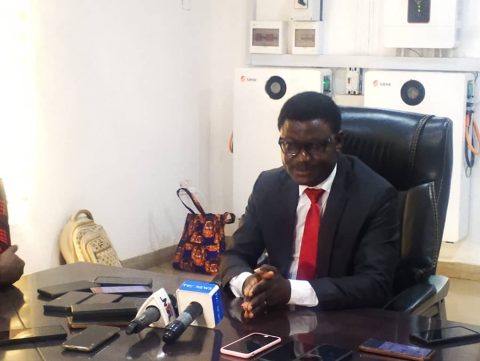
(AFRICAN EXAMINER) – Against the backdrop of rising public concerns and social media speculations about taxation in Enugu State, the Executive Chairman of the Enugu State Internal Revenue Service (ESIRS), Mr. Emmanuel Nnamani, has provided clarifications on the government’s tax policies.
He further added that the government is operating within the provisions of the law.

Briefing newsmen in Enugu on Thursday, Nnamani dismissed what he described as “false and misleading claims” in the social media, and reassured residents that the government’s fiscal operations are firmly rooted in law, transparency, and public good.
Clarifying misinformation and affirming legality of his operations, the ESIRS boss, stressed that no taxes or levies in Enugu state are imposed outside the provisions of the law.
“Taxes and revenues in Enugu State remain within the limits of the law. We do not impose any levies outside what the law permits, pointing to the Personal Income Tax Act (as amended) as the guiding legal framework.
He explained that the ESIRS collects personal income tax through two lawful means: Pay-As-You-Earn (PAYE) for those in formal employment, and Direct Assessment for informal sector workers.
“While compliance among salaried workers has been largely smooth, the agency sometimes employs legal enforcement mechanisms to ensure compliance among self-employed individuals.
Formalising the Informal Sector, a key challenge, he noted, has been bringing the informal sector especially market traders and transport operators into the formal tax net.
He said upon assuming office, his administration discovered that an overwhelming 99% of informal sector actors were not remitting taxes to the state, largely due to the disruptive influence of non-state actors engaged in illegal collections.
“In response, the government introduced a consolidated ₦36,000 annual levy for market traders.
‘This amount, payable between January and March, covers all relevant state-level charges, including those by the Enugu State Waste Management Agency (ESWAMA), Enugu State Structures for Signage and Advertisement Agency (ENSSAA), storage fees, and business premises levies.
“Once this amount is paid between January and March, the trader owes nothing else for that year,” Nnamani clarified. Traders who fail to pay by March 31 are subject to enforcement.
“For street vendors operating outside structured markets, an annual levy of ₦30,000 applies, with ESWAMA charges handled separately. Transport operators such as Okada riders, Keke drivers, minibuses, tankers, and trucks pay via a daily ticketing system.
He said to ensure a human-Faced approach to enforcement, although the law allows for a 10% penalty on unpaid tax and an interest charge tied to the Central Bank’s Monetary Policy Rate of 27.5%, Nnamani disclosed that the state has adopted a softer, pro-business approach.
“Instead of the full punitive charges, a flat ₦3,000 penalty is applied in most informal sector cases to promote ease of doing business and encourage voluntary compliance.
Addressing growing concerns over rising rent, Nnamani rejected claims linking the trend to state tax policies, describing the issue as a national challenge influenced by supply and demand, rather than fiscal policy.
He cited personal experiences dating back to 2015, observing that a shift in private development preference – from rental apartments to gated residential estates – has contributed to the housing squeeze.
“If we had more high-rise buildings, rent would drop,” he noted. The state government, he added, is taking proactive steps through the Ministry of Housing and Housing Development Corporation to build mass housing and student hostels near institutions like ESUT and IMT, freeing up central city housing and helping moderate rents.
Speaking further he noted that in line with its commitment to transparency and digital innovation, the ESIRS has launched a tax calculator on its official portal – www.irs.en.gov.ng – allowing residents to compute their taxes with ease and clarity.
“This is about transparency and giving our people confidence,” he said, inviting residents to compare Enugu’s tools with those in more advanced states like Lagos.
Responding to concerns that Enugu has become one of Nigeria’s most expensive states, Nnamani acknowledged the perception but clarified that the temporary inflation is largely demand-driven.
“With Enugu undertaking widespread infrastructural renewal – including smart schools, primary health centres, and hospitality infrastructure – the surge in construction activity has led to increased demand for building materials like granite and rods, which are sourced from other states.
“Once these projects are completed, demand will drop, and prices will stabilize,” he assured. He emphasised that the projects are visible testaments to what taxpayers’ money can achieve when properly managed.
He explained that the briefing serves as a reminder of the symbiotic relationship between citizens and government.
He appealed for public understanding, noting that when citizens fulfil their tax obligations, the government can, in turn, provide essential services and infrastructure that uplift everyone.
According to him, the message is to promote responsible taxation, managed transparently and invested wisely, is the bedrock of sustainable development.”

“From roads to schools and healthcare to housing, Enugu State is demonstrating how taxpayers’ money, when efficiently deployed, can improve lives and build the future.




Short URL: https://www.africanexaminer.com/?p=103963